Featured

Dear Marco,

What’s up? It’s quite strange how you’re simultaneously typing out and reading this letter to yourself. It’s as if your own thoughts are echoing in your brain. Hello-o-o-o… Hi-i-i-i… (good use of the 500-700 words there, buddy).

Right now, you’re writing this letter to yourself to tell yourself how you see who you really are (this doesn’t get any less confusing). I’m going to be honest with you, dude. The question of “How do you understand yourself?” is an extremely hard one to answer in some profound way.

What am I supposed to tell you? How am I supposed to define you? I could say you’re a college student, but you are not your occupation. I could say you’re a male but you are not your gender. I could say you’re a Filipino but you are not your nationality. Any traits I assign you or values I define you by are subject to change, but that doesn’t make you any less YOU. You’re a culmination of all of these things, and at the same time these traits and characteristics are defined by you and your actions.

If we look at it that way, there is no way for me to holistically say who exactly you are right now because you are never the same wherever or whenever you are. In reality, there is no authentic version of yourself that you’re forced to preserve in whatever situation you’re in. You’re a different Marco around your friends than when you are around your family. You were a different Marco in preschool than now that you’re in college. You’re even a different Marco when you’re alone. All of these versions of you are equally YOU; none of them are more authentic than the other.

So, my answer to the question of “How do you understand yourself?” is that rather than as the culmination of your traits, beliefs, and everything alike, I see you as the culmination of all past to future versions of yourself. You will act differently among different people and in different situations. You will change as time goes by. You will learn to like new things and drop things you once thought you liked. None of that will ever compromise who you are. It’ll simply change a version of you and how that version interacts with the rest of you.

Don’t get me wrong, that doesn’t make your identity completely fluid. There’re certain values and characteristics that will stay among most if not all versions of you. You aren’t completely at the whim of your environment when it comes to how you speak and act. In the end, it’s up to you to judge whether or not a certain version of you needs to change or isn’t someone you want to be. So, I guess right now you’re just a person navigating through college life, maintaining who you used to be while simultaneously trying out new versions of you and seeing what sticks. THAT’S how I see you.

Good luck in college, dude. I hope that whoever you become; you’ll end up liking all versions of them.

Sincerely,

Marco (the version that just finished writing this)
The Synthesis

Looking back on most of my blog entries throughout the semester, most of them involve me trying to relate lessons to aspects of my life I enjoy. In a way, I felt doing this was the most appropriate approach to applying the lessons I learnt in SocSc 11. I believe we shouldn’t have to look too far when it comes to applying a subject literally titled “Understanding the Self”, especially given there’s so many aspects of our lives that apply lessons in Social Science without us even realizing it.

Some lessons throughout the semester I found easier to contextualize than others, especially as a college freshman. Individuation and the influence of peers is the first that often comes to mind. Starting out college, everyone’s given the chance to rebrand and redefine their own cliques and crowds. However, we’re often unaware of how these cliques and crowds reshape us as well, especially as emerging adults. Our lesson and group discussions on gender identity and sexual orientation captivated more interest in class as well, as it’s during this time that romance and sexuality became a valuable pursuit for many. Ultimately, that lesson solidified the often-told importance of loving and being comfortable with oneself before sharing that love with others. It was the lessons like these I felt delivered on the promise that was made in the start of the year that SocSc is meant to assist in our transition into life within Ateneo. 

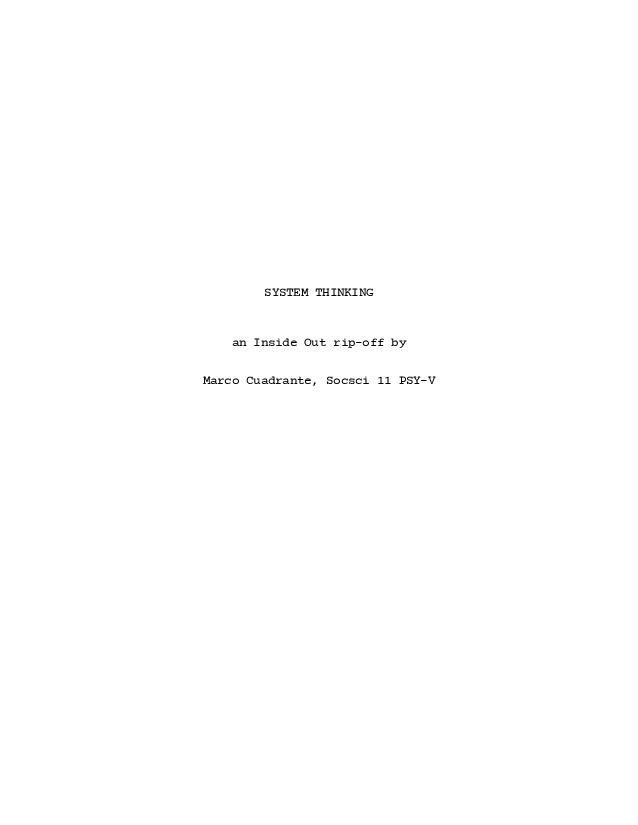
Some concepts, on the other hand, I felt were farther apart from my current context than they actually were. I recall systems thinking to be off-putting for me at first, as it seemed like the type of overly analytical topic that tends to repel people from Social Science; it almost crossed the line to becoming biological for me. I won’t lie by saying that I had the same sentiment when we discussed our first lesson, globalization and hybrid identities. However, having reflected on them more while writing my blog entries, I realized that “farther from my context” wasn’t the right term to use. Rather, these lessons were more general to everyone’s context, more timeless ideas to remember as we live in society.

Throughout the semester, I learnt a lot more about human nature and the components of both people and society. While I may have difficulty applying everything I’ve learnt in my current context, what I learnt in SocSc will hopefully stick with me as I continue to participate in the world around me.

A Recipe for a Genderbread Person

one cup of biological sex,

male or female (or perhaps neither…. or perhaps both?);

some tablespoons of gender,

doesn’t have to be the same as the sex;

a dash of expression,

adjust the femininity to your liking;

a pinch of orientation,

add more and more til you’re head over heels for someone,

and think that they’re the one;

and finally,

a little bit of whoever you want to be,

it’s your dish, after all;

make it your own.

P.S. Don’t forget the butter.

My Skyrim Character and Me

I received a copy of the game Skyrim as a present for my 13th birthday. The game promised that I’d get to play as a warrior that fought dragons and creatures alike using awesome weapons and magical abilities. However, when I first opened the game, I was instead greeted with a menu that contained a list of choices and a question:

“What is your character’s race/origin?”

The options were clear and distinct from one another, and the consequences the player would face for making those choices were made clear from the beginning. If you were a lizard, you could breathe underwater; If you were the cat, you could jump higher and move faster; If you were the elf, you were better at magic. Remembering my time playing Skyrim while watching Amara Pope’s TED talk on hybridity had me wishing “If only it were that easy.”

I know that my hybrid identity is much messier and less clear than the identity of my character in Skyrim. I, much like everyone else, am comprised of so many different global and local aspects that cannot be simplified into one question on a menu screen.

“What are the global aspects of your character?”

I would consider my interests and passions as more global aspects of my being than local. Being raised during the exponential rise of the Internet, I found myself learning to like so many things and participating in so many communities that I wouldn’t have been able to do in any other time. I learned about popular artists like Queen and how to play the guitar on Tabs; I started getting into video games like Skyrim because of YouTube videos; and I was able to connect to and get inspired by so many artists on Tumblr. The Internet and the globalization it brought about has played such a huge role into developing my passions and talents, which I cherish as a part of myself.

“What are the local aspects of your character?”

I would consider my personal values and beliefs as my local aspects that I picked up as a Filipino. In contrast to my global aspects, my local aspects are the parts of my being I can attribute to my upbringing and immediate environment. However, it can be quite difficult to distinguish what aspects are ‘completely local’ simply because of how diverse and intertwined with the world Filipino culture is. For example, I would consider my faith as a local aspect of myself, even though Roman Catholicism is practiced globally, because Christianity itself has been hybridized here in the Philippines. Practices like the Salubong , Noche Buena, and Pista ni San Juan make religion in the Philippines so unique that I would consider it part of my local identity. I would also consider my respect for elders and my sense of family (even with those who I’m not related to) as local aspects of my being as well. My local aspects are how I relate to other Filipinos on a daily basis, and I believe they have formed me to be a more loving person.

Despite how I’ve been discussing them in the past paragraphs, my global and local aspects are not independent of each other. I’ve used my global knowledge to gain a better understanding and love for local culture. I’ve used the local values I have in my global interactions, whether that be online or when I travel abroad. The constant back-and-forth of my global and local aspects is what led to the formation of my hybrid identities, which in turn formed me as a person.

“Are you happy with your character choice?”

I am happy with who I’ve ended up becoming so far through these aspects, but I hope to continue to let all aspects of myself grow as I make myself the best person I can be. Might be a little while before I slay a dragon though.

“Character confirmed. Welcome to Skyrim.”

Design a site like this with WordPress.com
Get started